
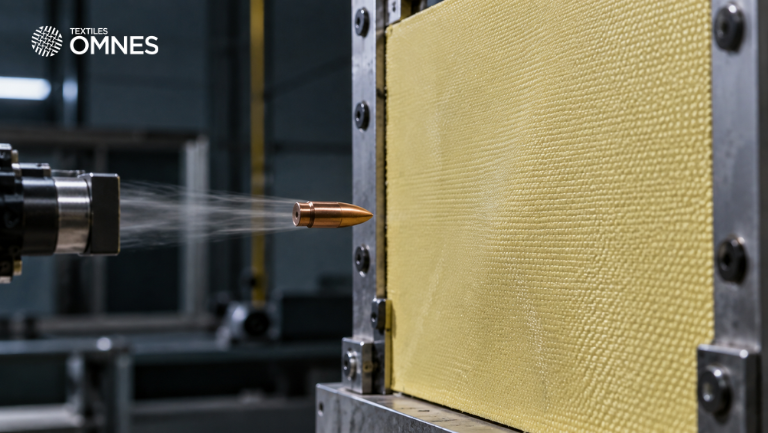
When a projectile strikes a ballistic protection system, its energy does not simply disappear. Part of that energy must be absorbed, distributed, and transformed by the materials that make up the protective system. In woven aramid fabrics, this process occurs within fractions of a second and depends not only on the properties of the fiber, but also on the fabric construction and the overall configuration of the ballistic system.
En los tejidos de aramida, este proceso ocurre en fracciones de segundo y depende tanto de las propiedades de la fibra como de la construcción del tejido y de la configuración completa del sistema balístico.
Summary
The role of woven aramid fabric in ballistic protection is closely related to the way its fibers and yarns respond to high-velocity impact.
When a projectile contacts the fabric, its kinetic energy begins to transfer into the material. The yarns located directly at the impact point deform and transmit stresses to surrounding areas of the fabric, progressively engaging a larger number of fibers.
In this article, we explain what happens during this process, how energy is distributed through woven aramid fabric, and why variables such as fiber properties, fabric construction, number of layers, and system configuration are critical to ballistic performance.
Table of Contents
- • What happens at the moment of impact?
- • How does woven aramid fabric respond?
- • How is energy distributed through the fabric?
- • Why are multiple layers used?
- • Factors that influence ballistic response
- • Why the complete system must be validated
- • Frequently asked questions about aramid fabrics and impact energy
• What happens at the moment of impact?
It all begins with the kinetic energy of the projectile.
When the projectile comes into contact with the protective system, part of this energy begins to transfer into the material. The impact creates very high stresses that are initially concentrated within a relatively small area.
The yarns that first come into contact with the projectile receive a significant portion of this load. From that point, stresses begin to propagate into surrounding areas of the fabric.
From a Localized Impact to a Broader Material Response
One of the functions of the woven structure is to help prevent the load from remaining concentrated exclusively at the initial impact point.
During this process, the yarns may:
- Stretch
- Deform;
- move relative to one another:
- generate fritction;
- transfer stresses to neighboring yarns;
- eventually break if their mechanical limits are exceeded.
These mechanisms contribute to the transformation and distribution of the energy generated by the impact.
• How does woven aramid fabric respond?
Aramid is a high-performance fiber known for its high strength-to-weight ratio.
During ballistic impact, the yarns located directly in front of the projectile are rapidly placed under tension.
Because of the woven structure, stresses can propagate in different directions through the warp and weft, allowing a greater portion of the material to participate in the response.
Yarn Strength Is Only Part of the Response
Although fiber strength is essential, the performance of a fabric does not depend solely on the strength of an individual yarn.
Other variables also play an important role, including:
- • fabric construction;
- • yarn density;
- • yarn crimp;
- • interaction between warp and weft;
- • friction between yarns;
- • areal density;
- • number and arrangement of layers.
For this reason, two fabrics made from fibers with similar characteristics may behave differently when subjected to the same impact conditions.
• How is energy distributed through the fabric?
During impact, the projectile’s energy can be transformed and distributed through several mechanisms within the textile system.
Part of the energy is associated with the deformation and elongation of the yarns.
Another portion can be dissipated through friction and relative movement between yarns.
The fabric may also experience transverse deformation around the impact area.
A Response That Occurs Within Fractions of a Second
Stress waves travel outward from the impact zone into other areas of the fabric.
The speed and efficiency with which these stresses are transmitted depend on factors such as the mechanical properties of the fiber, the fabric construction, and the interaction between the yarns.
The more effectively yarns and fibers are engaged in the response, the greater the amount of material available to help manage the energy transferred during impact.
• Why are multiple layers used?
In many ballistic applications, a single layer of fabric is not sufficient to manage all the energy associated with an impact.
For this reason, multilayer constructions are commonly used.
Each layer may play a different role during the event. The first layers are exposed to a significant portion of the initial load, while subsequent layers continue to contribute to deformation, stress redistribution, and energy management.
More Layers Do Not Automatically Mean a Specific Protection Level
The number of layers alone does not determine the ballistic performance of a system.
Other variables must also be considered, such as:
- • fabric reference;
- • areal weight;
- • fabric construction;
- • fiber type;
- • assembly method;
- • projectile type;
- • impact velocity;
- • final system configuration.
For this reason, any solution intended for ballistic protection must be properly designed and validated through the corresponding ballistic testing.
• Factors that influence ballistic response
The behavior of woven aramid fabric during impact is the result of several variables acting simultaneously.
Fiber Properties
Tensile strength, modulus, elongation, and fiber density influence how stresses are transmitted and distributed throughout the material.
• fabric construction;
The fabric architecture determines how yarns interact and how stresses are transferred between the warp and weft directions.
Variables such as yarn density, weave structure, and crimp directly affect the material’s response.
Friction Between Yarns
During impact, yarns may move relative to one another.
The friction generated between them influences fabric deformation and contributes to the dissipation of part of the impact energy.
Multilayer Configuration
The number of layers, their arrangement, and the way they are integrated all influence the overall response of the system.
For this reason, each configuration must be evaluated as a complete system rather than solely on the basis of the properties of an individual fabric layer.
• Why the complete system must be validated
Woven aramid fabric is one component within a ballistic protection solution.
Understanding the properties of the material is essential, but those properties alone are not sufficient to determine the final protection level.
Performance depends on the interaction between: fiber + fabric + multilayer construction + integration method + impact conditions.
Ballistic testing makes it possible to evaluate how a specific configuration performs against a defined threat under established test conditions.
Conclusion
When a projectile impacts woven aramid fabric, its energy begins to transfer into the material within fractions of a second.
The yarns are placed under tension, stresses propagate through surrounding areas of the fabric, and different mechanisms involving deformation, friction, and material resistance contribute to managing the energy generated by the impact.
However, ballistic performance does not depend on a single property.
Fiber characteristics, fabric design, number of layers, system configuration, and impact conditions all work together as part of the complete protective system.
For this reason, the final configuration must be properly designed and validated through the appropriate ballistic testing.
• Frequently asked questions about aramid fabrics and impact energy
Does aramid absorb all the energy from a projectile?
Not necessarily. During impact, energy is transformed and distributed through different mechanisms within the protective system.
How does the fabric help distribute impact energy?
The interlaced warp and weft structure allows stresses to be transferred from the yarns directly affected by the projectile to surrounding areas of the fabric.
: Do more aramid layers automatically mean greater protection?
Not necessarily. The number of layers is only one of several variables that influence the performance of a ballistic system.
Does fabric construction affect ballistic performance?
Yes. Variables such as yarn density, fabric architecture, yarn interaction, and areal weight influence how the material responds during impact.
Why is ballistic testing necessary?
Because ballistic performance applies to the complete configuration tested under specific conditions, not only to the individual properties of the fiber or fabric.
At Textiles Omnes, we develop woven aramid fabrics for ballistic protection applications, considering textile construction variables designed to meet different technical requirements.
If you would like to learn more about our aramid fabric references and their applications, our team will be glad to assist you.

