
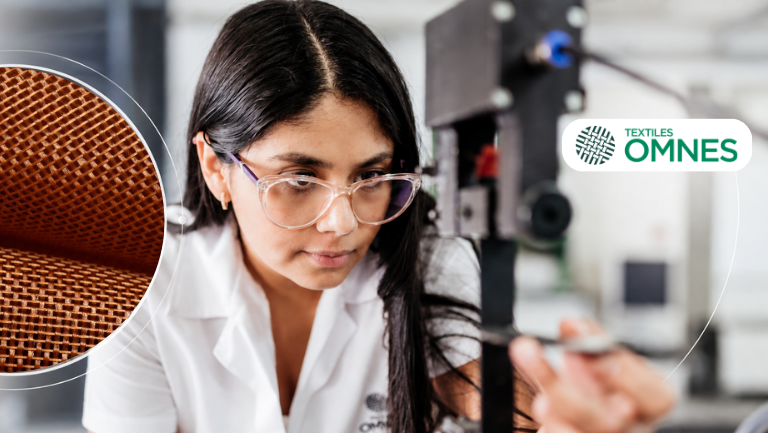
In technical textiles, a fiber is only the starting point. For it to become a material capable of performing consistently in an industrial application, several decisions come into play, including raw material selection, fabric construction, process control, and verification of its properties.
Reliability does not depend solely on whether a fabric meets a specification at the end of the process. It also requires consistency between what was designed, what is manufactured, and what the customer receives over time.
Summary
A reliable technical fabric is the result of multiple variables working together. Fiber type, structure, warp, weft, weight, width, traceability, and quality controls all influence its final behavior. In this article, we explain why controlling these variables helps reduce uncertainty and improve material consistency in industrial applications.
Table of Contents
- • Why is fiber only the starting point?
- • How fabric construction influences performance
- • Controlling variables during manufacturing
- • Traceability: following the material through its process
- • Why measurement and verification matter
- • Consistency between production runs
- Conclusion
- Frequently Asked Questions (FAQs)
Why Is Fiber Only the Starting Point?
Each fiber has its own characteristics. Polyester, polyamide, and aramid, for example, can offer different levels of strength, elongation, thermal stability, or behavior under specific service conditions. However, choosing a fiber with good properties does not by itself guarantee the performance of the finished fabric.
The selection process should begin with the application. A fabric intended to reinforce a rubber product requires different characteristics from one used in filtration, ballistic protection, or geotechnical solutions. Therefore, the key question is not only “which fiber is stronger?” but rather “what must the fabric contribute within the final product?”
How Fabric Construction Influences Performance
Two fabrics made from the same fiber can behave differently if their construction changes. The relationship between warp and weft, yarn density, yarn count, weave pattern, and weight per unit area affects how the material distributes loads and performs during use.
Warp refers to the yarns that run lengthwise through the fabric, while weft crosses them in the transverse direction. Their balance influences properties such as strength, coverage, flexibility, and stability. For this reason, the fabric structure should be defined according to the expected performance of the material rather than as an isolated manufacturing configuration.
Controlling Variables During Manufacturing
Once the construction has been defined, the challenge is to reproduce it consistently. During manufacturing, several variables that can affect the final behavior of the fabric are controlled, including:
- • Material width.
- • Warp and weft density and regularity.
- • Weight per unit area.
- • Construction and dimensional characteristics.
- • Compliance with the parameters defined for each reference.
Controlling these variables during the process helps identify deviations before the material moves on to subsequent stages. In industrial textiles, this is especially important because the fabric is often laminated, coated, vulcanized, impregnated, cut, or integrated with other materials.
Traceability: Following the Material Through Its Process
Traceability makes it possible to connect a material with the information generated during its manufacture. Identifications, lot numbers, and control records help reconstruct the path of a production run and understand what happened before the fabric reached the customer.
This is useful when a specific behavior needs to be analyzed, a deviation reviewed, or different production runs compared. Traceability is not simply a way to identify a roll; it turns the process into accessible information and supports better decision-making.
Why Measure and Verify Before Relying on a Fabric?
Many properties of a technical fabric cannot be evaluated by sight alone. Two materials may look similar and still behave differently when exposed to tension, temperature, friction, impact, or subsequent transformation processes.
For this reason, physical, dimensional, or mechanical characteristics are verified according to the application. Testing makes it possible to compare actual results with defined specifications and provides objective information about the material. In other words, appearance may be similar; data shows whether performance is as well.
Consistency Between Production Runs
In an industrial process, producing a correct result once is not enough. Customers need the material’s relevant characteristics to remain within defined parameters across successive production runs. This repeatability helps reduce unexpected adjustments in processes such as lamination, coating, vulcanization, sewing, or assembly.
Consistency does not mean that every meter is absolutely identical, but rather that variation remains within controlled tolerances. For this reason, one of the strongest indicators of reliability is the ability to deliver predictable material over time.
Conclusion
Confidence in a technical fabric is built through a chain of decisions: selecting the right fiber, defining its structure, controlling process variables, maintaining traceability, and verifying the properties that matter for the application.
At Textiles Omnes, this approach is part of the development and manufacturing of technical fabrics for different industrial applications. Fiber is the beginning; knowledge, control, and consistency are what turn it into a reliable material for the next stage of the value chain.
Frequently Asked Questions (FAQs)
Which variables influence the reliability of a technical fabric?
Key variables include fiber selection, fabric construction, warp and weft density, weight, width, dimensional stability, traceability, and the mechanical properties defined for the application.
Why is traceability important in industrial textiles?
Because it makes it possible to connect the material with its lot, manufacturing path, and process controls, supporting later analysis and follow-up of each production run.
Why is final inspection alone not enough?
Because many deviations can originate during manufacturing. In-process control helps identify them in time and supports consistency in the final product.

