
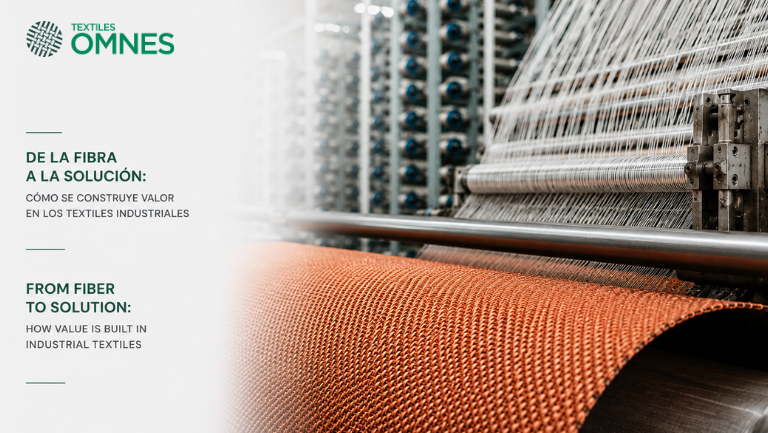
Industrial textiles are materials developed to fulfill specific technical functions in sectors such as tires, hoses, industrial reinforcement, and fluid conveyance. Their value is built from fiber selection to the engineering applied at each stage of the textile process.
Summary
The performance of an industrial textile depends on multiple factors: the selected fiber, the yarn design, the fabric structure, and the transformation processes applied. In this article, we explore how value is built from the fiber to the final solution and why textile engineering has become a key element in developing materials that are more efficient, resistant, and adapted to industry needs.
- Table of Contents
- • Fiber as the Starting Point
- • Performance-Oriented Textile Engineering
- • From Material to Industrial Solution
- • The Value of Working with a Technical Partner
- • Frequently Asked Questions About Industrial Textiles
- Table of Contents
En Textiles Omnes, entendemos que un textil industrial no se limita a un tejido o a una materia prima específica. Cada desarrollo representa una combinación de ingeniería, conocimiento técnico y procesos diseñados para responder a condiciones reales de operación.
Materials such as polyester, nylon, or high-performance fibers offer specific properties that directly impact the behavior of the final product.
• Fiber as the Starting Point
Every industrial textile development begins with a fundamental decision: choosing the right fiber.
Materials such as polyester, nylon, or high-performance fibers offer specific properties that directly impact the behavior of the final product.
Properties That Define Performance
Depending on the application, the fiber can provide characteristics such as:
- High mechanical strength
- Dimesional stability
- Flexibility
- Thermal resistance
- Compatibility with rubbers and resins
Proper fiber selection is the first step in developing an efficient and reliable solution.
• Performance-Oriented Textile Engineering
Once the fiber has been selected, the next step is to design the appropriate textile structure for the industrial application.
Variables such as yarn type, twist, fabric density, and subsequent treatments determine how the material will behave under real-use conditions.
Processes That Transform Material Behavior
Processes such as twisting, taslanizing, thermal treatments, or impregnation make it possible to modify material properties to improve:
- Adhesion
- Stability
- Structural strength
- Integration with industrial compounds
Textiles engineering thus transforms a fiber into a functional solution for high-performance applications.
• From Material to Industrial Solution
The true value of an industrial textile appears when it responds to a specific need within the customer's production process.
Beyond the material itself, the goal is to develop solutions that enable:
- • Improving final product performance
- Optimize manufacturing processes
- • Increasing durability
- • Reducing operational risks
- • Improving the cost-benefit ratio
Therefore, developing industrial textiles requires understanding both the material and the conditions of application and operation.
• The Value of Working with a Technical Partner
At Textiles Omnes, we support the development of textile solutions from fiber selection to the final product configuration.
Our experience in industrial textiles allows us to integrate technical capabilities, application knowledge, and production flexibility to respond to different industry needs.
More than manufacturing textiles, we seek to develop solutions that generate real value in our customers' performance.
Conclusion
The value of industrial textiles is built step by step. From fiber selection to transformation processes and final application, every decision influences the product's performance, efficiency, and reliability.
In an increasingly demanding industry, developing materials with purpose has become a key factor in improving processes and responding to high-performance applications.
Frequently Asked Questions (FAQs)
What differentiates an industrial textile from a conventional textile?
An industrial textile is designed to fulfill specific technical functions related to resistance, stability, or reinforcement. Its main focus is performance, not aesthetics.
Why is fiber selection important?
The fiber defines fundamental properties such as mechanical strength, flexibility, and durability. Proper selection makes it possible to develop more efficient solutions adapted to each application.
How does textile engineering add value?
Textile engineering makes it possible to design structures and processes adapted to specific needs, optimizing material behavior and final product performance.
At Textiles Omnes, we develop industrial textile solutions designed for high-performance applications.
To learn more about our capabilities and technical developments, our team will be ready to advise you.

