
When a company evaluates ballistic protection solutions, terms like "panels," "layers," or "armor" are often used as if they were simple components. In reality, an aramid ballistic panel is a sophisticated structure designed to manage energy: decelerating the projectile, distributing forces, containing fragments, and limiting backface deformation toward the user or the vehicle’s interior.
In this article, we provide a secure, non-operational overview of the journey "from fiber to armor": how aramid is transformed into a component ready for integration into bulletproof vests or vehicle armoring systems. Our goal is to help buyers, integrators, and manufacturers understand the engineering behind a material that has become essential to the industry.
1. The Fiber: Why Aramid Stands Out
Aramid belongs to a family of high-performance fibers renowned for their mechanical strength and thermal stability. Its toughness doesn’t just come from being a "strong material," but from its molecular structure, which is specifically oriented to withstand tension, impact, and fatigue.
From an application perspective, this results in a remarkable strength-to-weight ratio. The final system can achieve high protection levels with significantly less mass than traditional metallic alternatives—a key factor for both user mobility and vehicle performance.
2. From Filament to Yarn: Consistency and Quality Control
Before being woven into a fabric, aramid goes through stages where filament uniformity, yarn strength, and load behavior are strictly controlled. For ballistic uses, consistency is critical: minor variations in batches, tension, or finishing can compromise the panel's performance.
This phase also establishes internal parameters for material traceability: identifying the batch origin and correlating it with production test results. For armoring projects, traceability reduces risks and facilitates long-term quality control.
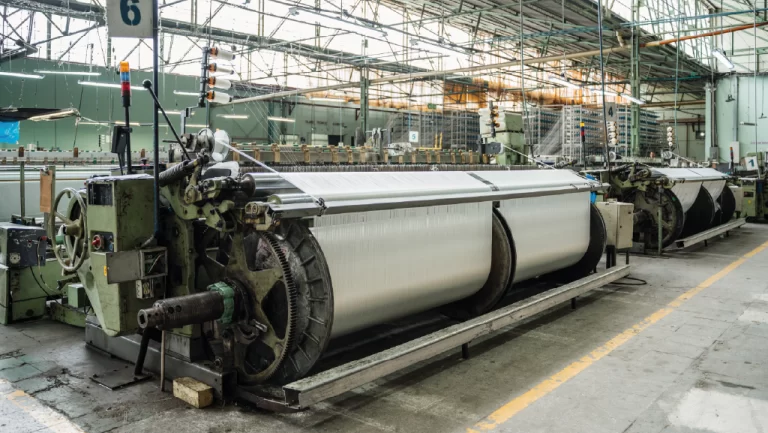
3. Weaves and Orientations: "Designing" Energy Absorption
At an industrial level, different architectures can be employed: bidirectional weaves (interlocked) or unidirectional structures (aligned fibers). It’s not a matter of one being "better" than the other; rather, each architecture offers specific advantages in terms of rigidity, flexibility, and energy distribution
In bulletproof vests, ergonomics and flexibility are paramount: the panel must contour to the body and maintain performance in real-world use. In vehicle armoring, the geometry of the protected area and the integration method determine the most suitable architecture.
4. Layer Stacking: From Textile to "System"
A ballistic panel is never just a single layer; it is typically a stack of layers with a defined orientation and sequence. The objective is to create a dissipation path: the initial layers begin the projectile’s deceleration, the intermediate layers distribute and absorb energy, and the final layers help control deformation and contain debris.
The selection of the layer count and configuration depends on the required protection level, target weight, and application type. For the end client, this translates into engineering decisions that seek the perfect balance between protection, comfort, and weight.
5. Compaction, Lamination, and Dimensional Stability
Once the structure is defined, the layers may be compacted or laminated to improve stability. Compaction reduces internal voids and increases panel consistency, ensuring that performance is repeatable across units.
Dimensional stability is especially important in vehicle armoring: the panel must maintain its shape despite vibrations and thermal cycles. In vests, it prevents the panel from "shifting" internally, helping to maintain the correct fit.
6. Integration in Vests
In bulletproof vests, the panel is integrated with ergonomics, coverage, and usage conditions in mind. It’s not enough to just "stop" the threat; it’s also crucial to limit backface deformation (blunt trauma) and maintain stability during repetitive movements.
In addition to the panel, there are typically carrier and encapsulation components designed to reduce exposure to moisture and contaminants, which directly impact the system's service life.
7. Integration in Vehicle Armoring
In vehicles, aramid is used to protect specific areas defined by the project. The main challenge is integration: the armor must fit the internal design, respect tolerances, and minimize impact on functionality.
A well-integrated system aims to maintain a discrete appearance, avoid additional noise or vibrations, and keep the driving experience as close as possible to that of a non-armored vehicle.
8. Testing and Certifications
Ballistic performance is validated through testing under recognized standards. Beyond the impact test itself, variables such as repeatability, post-impact deformation, and the integrity of the assembly are evaluated.
For the buyer, testing and certifications provide an objective way to compare solutions and demand traceability and compliance.
The journey "from fiber to armor" shows that aramid is not just a material, but a technological platform that relies on design, process, and quality control. A reliable panel is the result of careful decisions in architecture, stacking, compaction, and integration. la aramida no es solo un material, sino una plataforma tecnológica que depende de diseño, proceso y control de calidad. Un panel confiable es el resultado de decisiones cuidadosas en arquitectura, apilamiento, compactación e integración.
Understanding these stages helps you formulate better specifications, make more informed purchases, and evaluate suppliers with clear technical criteria.


