
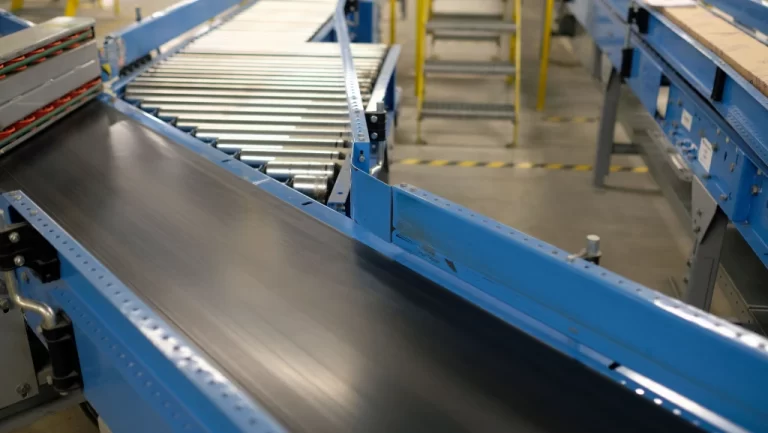
A conveyor belt system is a continuous transport machine designed to move products or raw materials using a rubber belt reinforced with technical fabrics that travels over rollers. The system operates via a motor that drives a head pulley (drive drum), which transmits motion to the belt through friction, enabling a constant and efficient logistical flow.
Table of Contents
- 1. Essential components of a conveyor system
- 2. The role of technical fabrics in the belt structure
- 3. Classification of belts by industrial application
- 4. Advantages of automation in material handling
- 5. The impact of rubber and textiles on system service life
- 6. Conveyor belts in the era of IT Infrastructure
- 7. Maintenance and structural failure prevention
- 8. Frequently Asked Questions (FAQ)
1. Essential components of a conveyor system
The components of a conveyor system work in an integrated manner to transform electrical energy into linear mechanical motion. The structure is based on a metal frame that supports the idlers (rollers), over which the belt slides. The drive pulley is responsible for "pulling" the belt, while the tail pulley completes the infinite circuit.
In infrastructure management, every component must be perfectly aligned. If rollers are dirty or worn, the belt will suffer unnecessary friction, damaging both the rubber cover and the internal fabrics, thereby increasing plant operating costs.
2. The role of technical fabrics in the belt structure
Technical fabrics are the structural soul of the conveyor belt, providing the necessary tenacity to withstand tension without the belt stretching permanently. In the rubber industry, fabrics such as polyester or aramid are selected because they offer superior dimensional stability, allowing the belt to support tons of weight while maintaining its original length.
Without these layers of technical fabric, the rubber belt would be unable to transmit the motor's force to the load. The fabric acts as a flexible skeleton that allows the belt to bend around pulleys while remaining firm under the pressure of heavy or sharp materials.
3. Classification of belts by industrial application
The configuration of fabrics and the rubber compound varies by industry, adapting to needs for temperature, chemical resistance, or friction. A system designed for mining requires nylon fabrics to absorb impacts, while a logistics center prefers polyester fabrics for greater precision over long distances.
| Industry | Primary FabricRubber Characteristic | Primary FabricRubber Characteristic |
| Heavy Mining | Nylon/Nylon (NN) | High impact and cut resistance |
| Express Logistics | Polyester/Nylon (EP) | Low noise and anti-static properties |
| Thermal Processes | Aramid | High-temperature resistance |
4. Advantages of automation in material handling
The automation of a conveyor belt system allows for precise control over speed and material flow, reducing production bottlenecks. By using variable frequency drives (VFDs), the system can achieve a soft start, protecting technical fabrics from sudden jerks that could weaken the fibers over time.
This technology is key in modern infrastructure, as it allows conveyor systems to stop or accelerate based on plant demand. This not only saves energy but also extends the service life of textile and mechanical components by avoiding unnecessary material stress.
5. The impact of rubber and textiles on system service life
The durability of a conveyor belt depends on how well the rubber protects the technical fabric from moisture and abrasion. If the rubber coating cracks, water can penetrate the textile fibers, causing mildew or internal corrosion that eventually leads to the separation of the belt layers (delamination).
In the rubber industry, special adhesion treatments are applied to ensure the textile and polymer function as a single unit. A well-manufactured belt can operate for years under adverse weather conditions, provided the rubber barrier remains intact to protect the structural core.
6. Conveyor belts in the era of IT Infrastructure
Today's conveyor belts are integrated into the IT ecosystem through sensors that monitor fabric health and alert users to premature wear. This convergence of mechanical and digital elements allows infrastructure managers to oversee plant performance from any connected device.
The ability to monitor belt tension and technical fabric alignment through software reduces the risk of catastrophic failure. By receiving real-time data, preventive adjustments can be made to ensure the conveyor system remains a reliable piece within the company's technological architecture.
7. Maintenance and structural failure prevention
Preventive maintenance must prioritize cleaning the rollers and checking the belt edges to prevent wear of the technical fabric due to lateral friction. A system that does not receive technical attention will develop tracking (alignment) problems that will "bite" the belt edges, leaving the fibers exposed.
Preventing delamination
It is vital to inspect for any bulges on the belt surface. These are usually signs that the fabric has separated from the rubber. If not treated in time, the bubble will grow until the belt breaks completely, causing a total shutdown of the logistical infrastructure.
8. Frequently Asked Questions (FAQ)
What causes the most damage to a conveyor belt's fabric?
The most damaging factors are the direct impact of sharp materials and poor alignment, which frays the technical fabric at the edges. When internal yarns are exposed, environmental moisture penetrates the structure, weakening the tensile strength of the entire belt.
Why is anti-static fabric important in logistical systems?
Anti-static fabric prevents rubber friction from generating static sparks that could damage electronic components or sensors within the IT ecosystem. In automated warehouses, this technical property is mandatory to ensure the integrity of digital equipment and personnel safety.
How do you know if a conveyor system is efficient?
A system is efficient when it moves the maximum amount of load with the lowest energy consumption, which is achieved by using belts with lightweight, low-friction technical fabrics. Reducing the belt's mass eases the motor's workload, optimizing infrastructure management and reducing annual operating costs.

