
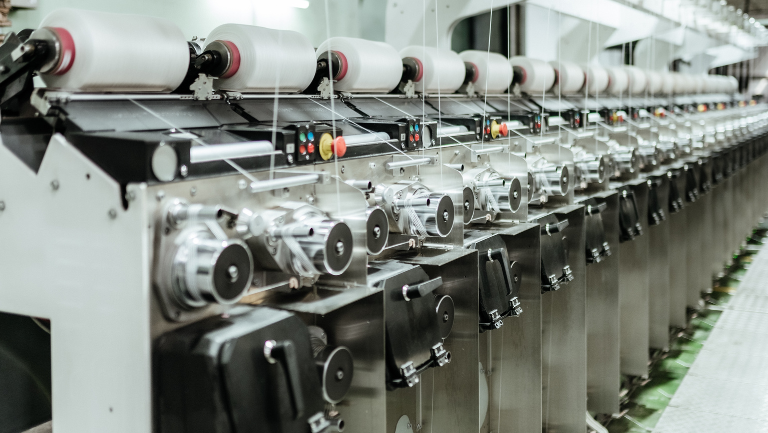
The chafer, also referred to as “lona” in certain industrial applications, is evolving through advancements in technical textiles for tires and high-pressure hoses.
Summary
The air-textured yarn is transforming the performance of chafer in tires and high-pressure hoses. Thanks to its structure, it enables full RFL penetration, achieving a complete seal that prevents air diffusion. In this article, we analyze how this technology positions itself as an efficient alternative to monofilament, improving adaptability, durability, and performance in demanding industrial applications.
Table of Contents
At Textiles Omnes, we have a strong track record in the development of polyester and nylon chafers, covering everything from monofilament structures to twisted and taslanized multifilaments.
In applications such as tires and high-pressure hoses, the chafer plays a critical role: protecting structural integrity and contributing to overall system performance. As a result, advancements in textile materials have a direct impact on the efficiency, durability, and reliability of the final product.
Taslanization and its relationship with zero air permeability
Taslanization is a physical transformation of the yarn achieved through high-pressure air, water, or steam jets, which create micro-loops and curls on the fiber surface.
This bulky structure allows the RFL (Resorcinol-Formaldehyde-Latex) solution to fully penetrate the fiber when woven into a chafer, achieving internal sealing after vulcanization.
This behavior is key to ensuring that air cannot pass through the material, thereby delivering optimal performance in high-demand applications.
Comparison of chafer structures
Air diffusion performance varies depending on the type of yarn used:
Monofilament
- Solid structure
- Sealing through polymer occupancy
- External RFL coating
- High stiffness
Twisted multifilament
- Individually sealed filaments
- Reduced interstitial spaces
- Limited RFL penetration
- Potential air leakage pathways
Taslanized multifilament
- Open and bulky structure
- Full RFL penetration between filaments
- Sellado integral
- Elimination of air diffusion
Taslanization as an alternative to monofilament
High-tenacity taslanized yarn is positioned as a functional alternative in applications where monofilament has traditionally been used.
Rigidez vs flexibilidad
While monofilament stands out for its structural rigidity, taslanized yarn offers greater flexibility without compromising the property of zero air permeability.
Adaptability in complex applications
In areas such as the tire bead:
- Monofilament can be difficult to position
- Taslanized fabric better adapts to complex geometries
- Structural integrity is maintained in tight angles
This facilitates assembly and enhances the performance of the final product.
Performance-oriented textile engineering
Taslanization transforms a conventional yarn into an optimized solution for high-performance applications within industrial technical textiles.
Its implementation in chafer enables:
- Enhance the material’s internal sealing
- Eliminate air diffusion
- Increase the durability of the final product
- Optimize manufacturing processes
Frequently Asked Questions (FAQs)
What advantages does taslanized yarn have over monofilament in chafer?
Taslanized yarn offers greater flexibility and adaptability without compromising the property of zero air permeability. Unlike monofilament, its structure allows better RFL penetration, achieving a more complete internal seal and facilitating its use in complex geometries such as the tire bead.
How does taslanized multifilament achieve zero air permeability?
Thanks to its bulky structure with micro-loops, taslanized multifilament allows the RFL solution to fully penetrate between the filaments. This results in a complete seal after vulcanization, eliminating any potential air leakage pathways within the fabric.
In which applications is taslanized yarn used in technical textiles?
Taslanized yarn is primarily used in chafer for tires and in high-pressure hoses, where structural strength, durability, and control of air diffusion are required. It is also applicable in other technical textile developments where internal sealing and adaptability are critical.
At Textiles Omnes, we design technical textile solutions focused on efficiency, durability, and performance. Our team can support you in selecting the most suitable material for your application.

