
The modern rubber industry—producing tires capable of sustaining speeds and loads unthinkable a century ago—stands as a testament to constant innovation. However, this feat of engineering was not achieved by improving rubber alone; it relied crucially on its silent partner: textile technology.
This article explores the fascinating evolution of Chafer fabric, the invisible reinforcement located at the tire bead, demonstrating how the transition from humble cotton canvas to high-modulus polymers has propelled automotive safety and performance.
The Immutable Role of the Chafer: A Shield Against Friction
The tire bead is the specific area where the tire creates an airtight seal against the vehicle's rim. It is a point of extreme tension, friction, and heat.
Defining the Challenge
Chafer fabric is a rubberized textile reinforcement layer wrapped around the steel bead wire. Its function is dual and critical:
- Mechanical Protection: It acts as a shield against the constant abrasive damage caused by flexing and microscopic movement between the rim and the tire.
- Mounting Facilitation: It protects the bead during mounting and dismounting, when tools exert high friction.
If the Chafer fails or the textile weakens, the steel bead can become exposed, ultimately compromising the tire's ability to retain pressure, leading to catastrophic failure.
Stages of Evolution: A Century of Textile Innovation
The history of the Chafer is a search for materials with greater thermal resistance and dimensional stability to meet the increasing demands of modern driving.
1. The Cotton Era (Early 20th Century)
- Material: Early tires relied on cotton canvas and fabrics.
- Performance: While affordable and easy to process, it offered limited strength. Cotton is hygroscopic (absorbs moisture) and degraded rapidly under heat and fatigue, limiting tire lifespan.
- Impact: This restricted load capacity and kept vehicle speeds relatively low, as overheating was a constant concern.
2. The Nylon Revolution (Mid-20th Century)
- Material: The introduction of Nylon (Polyamide), a synthetic polymer, transformed the industry.
- Performance: Nylon offered dramatically higher tensile strength than cotton and excellent fatigue resistance, enabling the production of safer, more durable tires.
- Challenge: While a giant leap forward, Nylon still showed considerable dimensional instability at high temperatures, which could cause minor deformations and affect tire uniformity at high speeds.
3. The Maturity of Polyester (Late 20th Century to Present)
- Material: High-Tenacity Polyester (PET) became the material of choice for most reinforcement fabrics, including the Chafer.
- Performance:The key to Polyester is its dimensional stability. It maintains its shape and length under heat and tension, ensuring the bead geometry remains precise. Furthermore, its low hygroscopicity ensures performance does not degrade in humid environments.
- Impact: Polyester is crucial for modern high-performance tires and advanced safety systems (such as Run-Flat tires), where bead stability is essential.
Textile Engineering in Modern Rubber: Reinforcement Technology
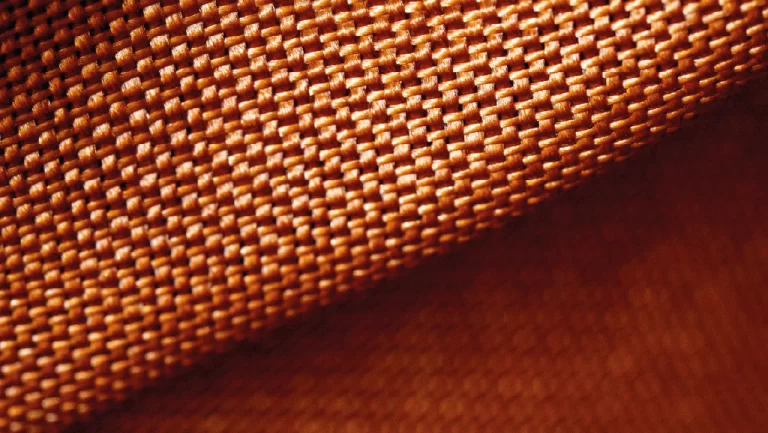
Today’s Chafer is not just Nylon or Polyester; it is a precision-engineered industrial fabric designed to fuse with rubber during vulcanization, creating a composite material stronger than its individual parts.
The rubber reinforcement textile industry meets the rigorous demands of the automotive and hose sectors, focusing on the molecular composition of the yarn and the structure of the fabric.
Key Technical Advantages:
- High-Tenacity Composition: Fabrics are made with High-Tenacity Monofilament or Multifilament yarns of Nylon 6.0, 6.6, or Polyester. This ensures maximum resistance against the tension and friction the bead endures throughout the tire's service life.
- Custom Structural Design: The weave is critical. Fabrics are produced with specialized weaves such as twill and plain weave (in various patterns like 1:1, 2:1, 2:2, 3:1), and Oxford. Options for twisted or textured (Taslanized) yarns allow for exact control over the fabric’s modulus and flexibility.
- Essential Molecular Adhesion: For the fabric to bond with the rubber, it must be treated. The industry uses fabrics impregnated with RFL (Resorcinol Formaldehyde Latex), a chemical compound essential for creating a perfect molecular bond with common rubber types (NR, SBR, and NBR).
- Fiber Versatility: Textile engineering manages a wide range of weights (typically 100 – 350 g/m²) and can incorporate specialized fibers like Aramid for applications requiring extreme heat or puncture resistance.
Impact on Safety and Economy
The evolution of the Chafer has had two direct and measurable effects:
1. Increased Speed and Safe Load Capacity
By reducing internal overheating and offering greater fatigue resistance, advanced polymers allowed manufacturers to design tires that handle heavier loads and operate at consistently higher speed ratings.
2. Extended Service Life and Reduced Wear
A robust, well-bonded Chafer minimizes internal bead wear. This is crucial for the circular economy of rubber; in retreading, the tread is renewed, but the bead (the tire's anchor) must remain intact.
Chafer fabric is a clear example of how textile engineering is fundamental to the rubber industry. Every time a vehicle accelerates, brakes, or corners at high speed, this invisible reinforcement is working to keep the bead secure and pressure stable. The constant evolution of polymers ensures the next generation of tires will be even safer, more durable, and more efficient.


