
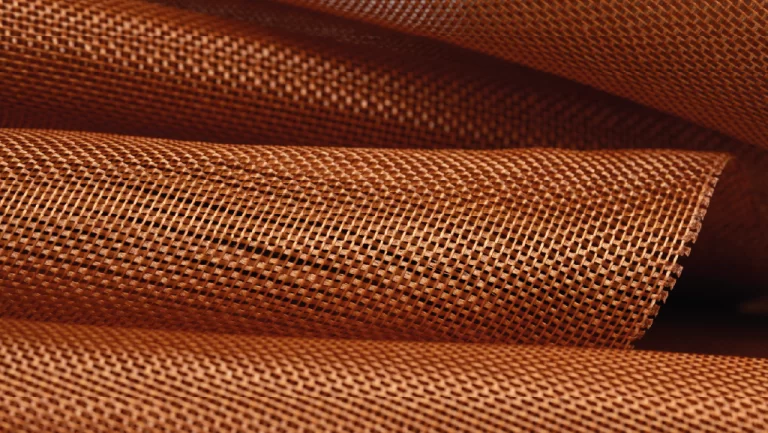
In the rubber industry, the strength and safety of every product depend on an invisible bond: the one connecting the rubber to technical fabrics.
Among these reinforcements, one essential yet little-known element stands out: chafera fabric that ensures adhesion, protection, and durability in critical areas such as the bead of tires, conveyor belts, or industrial products facing constant wear.
The chafer is, essentially, the link that allows two opposing materials to work as one. Without it, the rubber structure weakens, and the performance of the final product is compromised.
The Challenge of Joining Rubber and Textiles
Rubber and textiles are materials with completely different natures. Rubber is elastic, dense, and has low porosity, while textiles are fibrous, flexible, and permeable. Achieving a strong and stable bond between the two is one of the biggest challenges in the rubber industry.
The chafer emerges as the technical solution to this challenge. This fabric acts as a reinforcement and anchoring barrier, allowing the rubber to adhere firmly without compromising the product's flexibility or shape. Thanks to its controlled structure and the surface treatments it receives, the chafer improves compatibility between the rubber and the textile or metallic layers,guaranteeing a firm and durable bond.
What Exactly Is Chafer?
Chafer is a technical reinforcement fabric placed in areas where friction, pressure, or heat are most intense. In tires, for example, the chafer protects the bead and prevents wear caused by contact with the rim or by constant movement.
In other applications within the rubber industry, it is used to reinforce structural joints, prevent deformation, and ensure that the rubber layers remain firmly bonded.
The chafer combines mechanical strength, thermal stability, and adhesion, tres cualidades que lo hacen indispensable en entornos industriales. Su desempeño depende del tipo de fibra empleada (poliéster, nylon o aramida), del trenzado del tejido y de los tratamientos que recibe antes de la vulcanización.
The Science of Adhesion
Joining rubber and textiles is a material engineering process, not a simple gluing. The key is to generate a chemical and mechanical adhesion that can withstand tension, heat, and continuous deformation.
Before application, the chafer undergoes surface treatments that modify its surface energy, facilitating the bond with the rubber. These treatments include adhesive coatings, resins, or special baths that promote chemical compatibility during vulcanization.
During vulcanization—the core process of the rubber industry—raw rubber is transformed into a stable material through the action of sulfur and temperature. It is at this point that the chafer must demonstrate its resistance: maintaining cohesion without degrading, even under extreme conditions of pressure and heat.
Factors Determining Chafer Adhesion
The effectiveness of the chafer depends on various factors involved in the rubber-textile bond:
- Type of Rubber: Natural or synthetic. Each one responds differently to adhesives.
- Chafer Fiber Type: Nylon, polyester, or aramid. Its structure influences the adhesive absorption and the flexibility of the whole assembly.
- Pre-Treatment: Cleaning, impregnation, and controlled drying to avoid contaminants.
- Vulcanization Conditions: Time, temperature, and pressure must be maintained within precise limits.
- Production Environment: Humidity or dust can alter the final adhesion.
When any of these variables deviates, the result is poor adhesion, which can lead to delamination, loss of shape, or structural failures. Therefore, process control is essential to guarantee product stability.
Innovation and Evolution of Chafer
Chafer has evolved significantly alongside the rubber industry. Early chafers were made from treated cotton, but the search for greater strength and lower weight led to the adoption of synthetic fibers.
Today, polyester and nylon fabrics predominate, offering an excellent combination of tenacity and elasticity.
In high-demand applications, such as radial tires or industrial products subjected to high temperatures, chafers with aramid fibers are used, capable of withstanding friction and fatigue without losing adhesion.
Furthermore, new chafer coatings, based on solvent-free adhesives and aqueous treatments, help reduce the environmental impact without sacrificing performance. This trend responds to the rubber industry's growing commitment to sustainability and responsible innovation.
Quality Control and Adhesion Testing
Every chafer batch undergoes tensile, peel, and thermal resistance tests before its industrial application. These tests ensure that the fabric maintains its properties under real working conditions.
During manufacturing, laboratories in the rubber industry also evaluate the bond strength between the rubber and the chafer through standardized tests. Internal cohesion, adhesive distribution, and resistance to detachment are analyzed. Any deviation in these results implies adjustments in the vulcanization parameters or the fabric treatments.
The ultimate goal is to ensure that the chafer acts as a durable link, capable of withstanding thousands of cycles of compression, torsion, and temperature without losing adhesion.
Future of Chafer in the Rubber Industry
The future of chafer is oriented towards efficiency, sustainability, and precision. New technologies seek to develop lighter fabrics with the same resistance, and adhesives that work at lower temperatures to optimize energy consumption.
Automation and digital process monitoring also contribute improvements: sensors that control coating uniformity or cameras that detect micro-defects before vulcanization.
On the horizon even appear smart chafers, with fibers capable of changing their behavior in the face of heat or friction, adapting dynamically to working conditions. These innovations promise to expand the performance limits of the rubber industry, making its products more durable and efficient.
The Invisible Fabric That Binds Everything
The chafer is much more than a reinforcement; it is the junction point that sustains the internal structure of the rubber. Its ability to adhere, resist, and protect defines the final quality of every product manufactured in the rubber industry.
Although it remains hidden between layers, its function is decisive: without the chafer, the bond between rubber and textile weakens, affecting the performance, safety, and lifespan of the entire system.
In a sector where durability and precision are essential, the chafer remains silent but vital.


